
100%
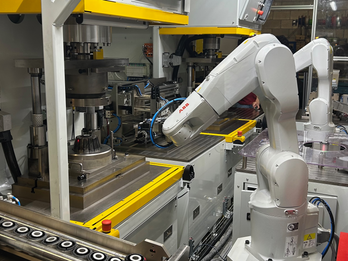
Robotic Hydraulic Press Cell with Laser Profiling and Testing
This robotic press automation cell was designed and built by AMD Machines to automate two 50 ton hydraulic presses. The system integrates part feeding, vision inspection, laser measurement, and performance testing into a continuous production flow with full automation between operations. Parts enter the cell through a step feeder that singulates and orients components for robotic pickup. Step feeders provide gentle handling and reliable feeding for a wide range of part geometries without the tuning complexity of traditional bowl feeders. A Keyence camera inspects each part before processing begins. Vision inspection verifies correct orientation, part presence, and surface quality before the first robot loads the part into the first hydraulic press. Catching defects early prevents bad parts from consuming downstream cycle time. After the first press operation, parts transfer to an inline inspection station equipped with laser profilers. The profilers measure critical dimensions and geometric features to verify that the pressing operation produced parts within specification. Measurement data is recorded for traceability and process monitoring. A second robot picks inspected parts and loads them into the second hydraulic press. This press receives ferrules from two dedicated step feeders that supply components continuously. The robot positions the part and ferrules together for the final pressing operation. Following the second press, finished parts move to a performance testing station. A servo press applies controlled force to each assembly while monitoring force and displacement feedback. This test confirms that assemblies meet required performance specifications and will function correctly in their final application. Parts that fail to achieve the necessary force signature are rejected automatically. The complete cell runs under a unified control system with an intuitive HMI for operator interaction. The interface displays cycle status, inspection results, measurement data, and reject tracking. Full traceability links each part to its inspection and test records throughout the process. AMD Machines has 150 employees and 30 years of experience delivering precision assembly and automation systems. Our Mexico headquarters and Chicago sales office make us the right partner for manufacturers who need reliable automation in North America. Contact us to discuss your application. | This robotic assembly cell was designed and built by AMD Machines for sensor manufacturing. The system handles final assembly, inspection, and laser marking while maintaining full traceability to support regulatory compliance requirements. Sensors enter and exit the cell through an automated tray handling system. Trays are loaded at the infeed station where a robot picks individual sensors and transfers them into the assembly process. After processing, finished sensors are returned to trays at the outfeed station. Tray based handling protects sensitive components, maintains orientation, and integrates easily with upstream and downstream operations. The assembly sequence begins with o-ring installation. A bowl feeder singulates and orients o-rings, presenting them consistently to the robot for pick and place onto each sensor body. Bowl feeder technology provides reliable high speed feeding for small components, ensuring consistent cycle times and minimal jams or misfeed conditions. Following assembly, each sensor passes through an inspection station. Vision systems and sensors verify correct o-ring presence, seating, and positioning. Dimensional checks confirm that assemblies meet specification before proceeding. Any part that fails inspection is flagged and diverted automatically, preventing defective product from continuing through the process. A laser marking station applies permanent identification to each sensor. Marks can include serial numbers, date codes, lot information, barcodes, or 2D data matrix codes depending on customer requirements. Laser marking provides durable identification that withstands harsh operating environments and supports downstream traceability throughout the product lifecycle. The cell is equipped with a comprehensive traceability and data management system. Every sensor is tracked from tray infeed through final outfeed. The system records assembly parameters, inspection results, and marking data for each unit. This information is stored locally and can be transmitted to plant level databases or MES systems for long term retention. Full traceability supports compliance with industry regulations and customer quality requirements. In the event of a field issue, manufacturers can trace affected product back to specific production lots, assembly dates, and inspection records. This capability is essential for industries where documentation and recall readiness are mandatory. The system is designed for ease of operation and fast changeover. Operators interact through an intuitive HMI that displays production status, cycle counts, and alarm information. Recipe management allows the cell to switch between sensor variants with minimal downtime. AMD Machines has 150 employees and 30 years of experience delivering precision assembly and automation systems. Our Mexico headquarters and Chicago sales office make us the right partner for manufacturers who need reliable automation in North America. Contact us to discuss your application.
Custom quote
Mã SKU:
- Đổi trả dễ dàng trong 30 ngày
- Đặt hàng trước 14:30 để giao trong ngày
Thanh toán an toàn và bảo mật


AMD MACHINES
(0 Đánh giá)
- Địa chỉ: 10330 Lake Rd, Suite F6, Houston, Texas, 77070, United States, Houston, Texas, United States
- Điện thoại:+1-832-745-1292
Robotic Hydraulic Press Cell with Laser Profiling and Testing
Custom quote


